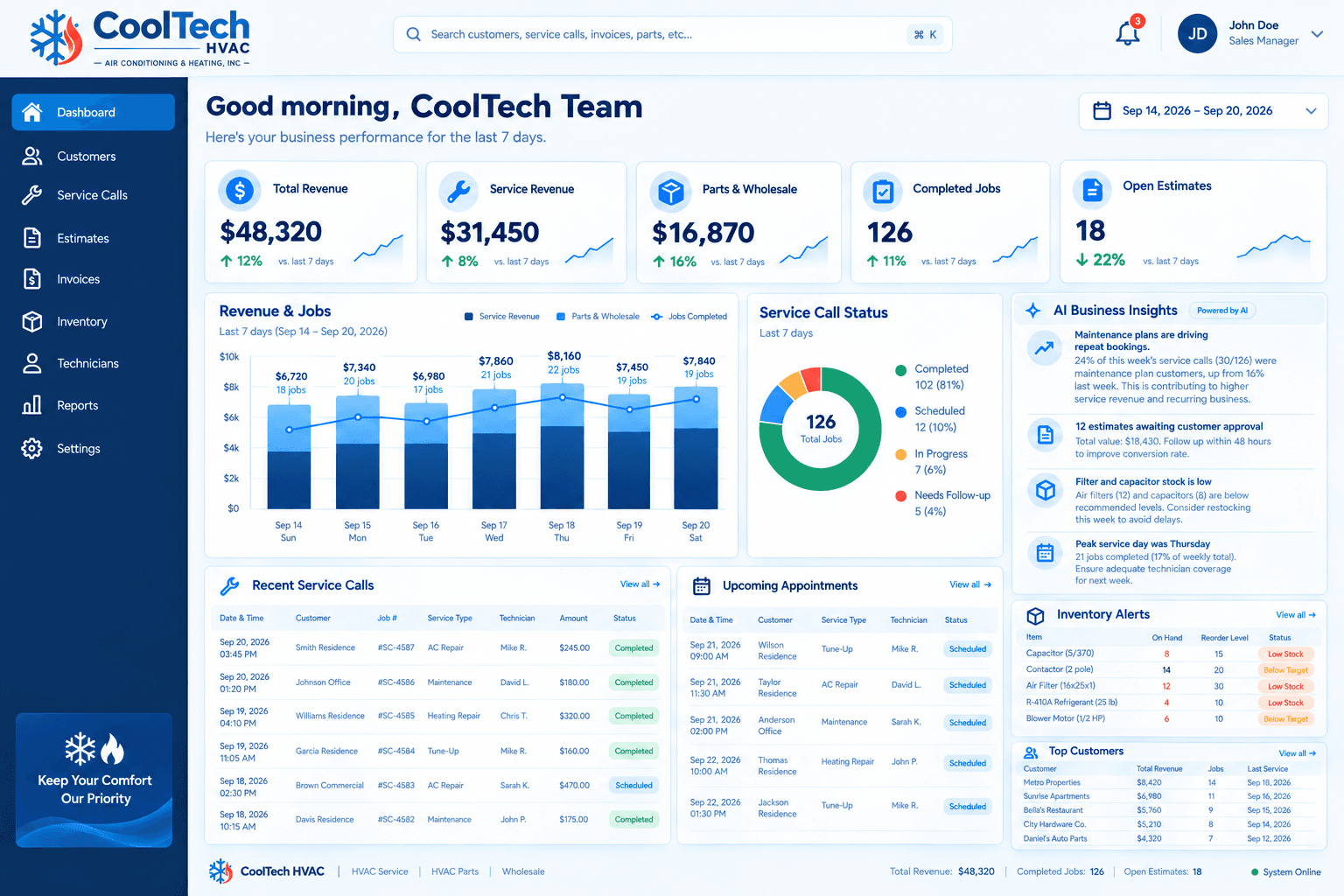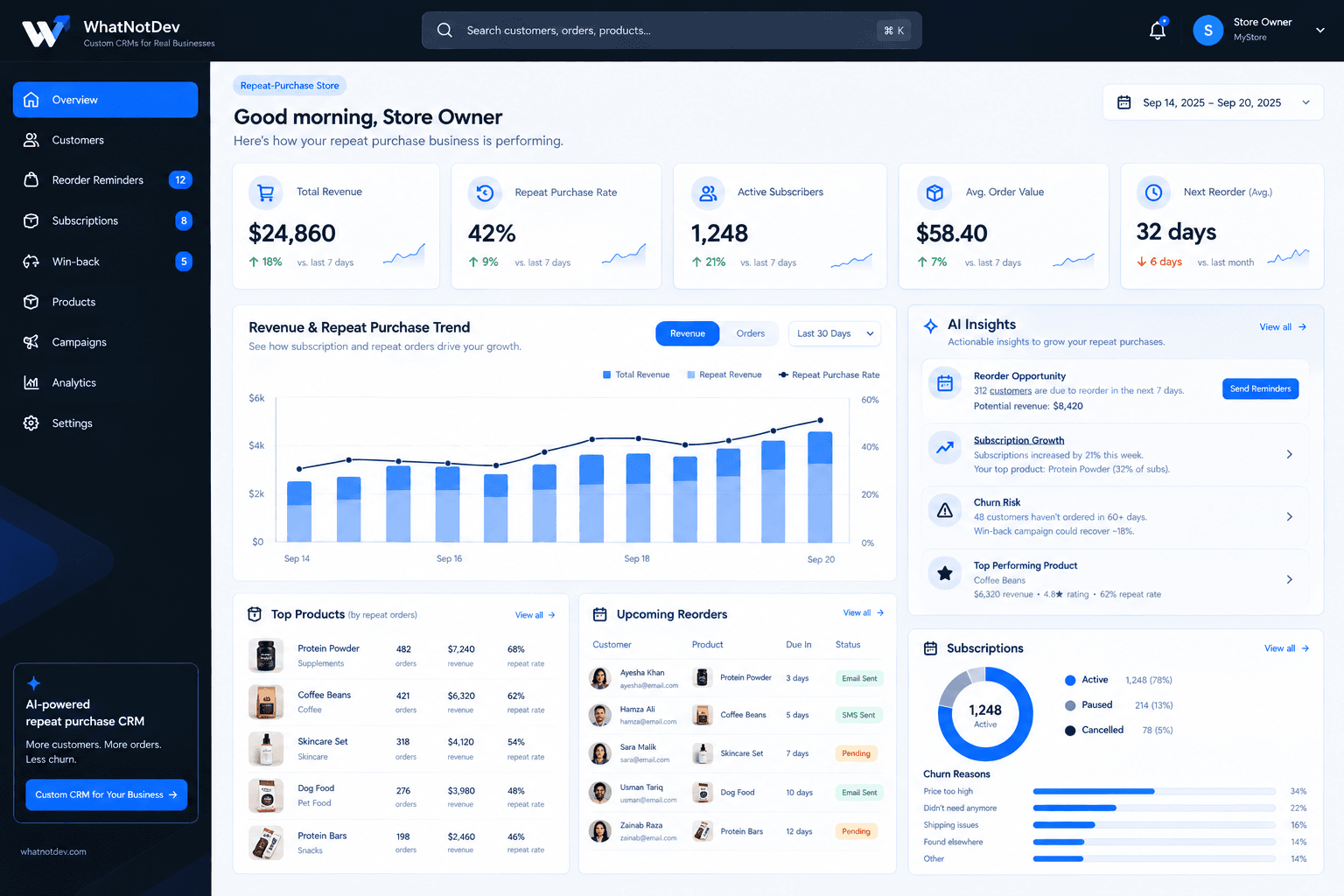
There is no universally best CRM. There is the one that fits the way your business runs, and the three options we see most often are a custom build, GoHighLevel, and HubSpot. We build on all three, so this comparison is meant to help you decide, not to sell you a particular one.
Below is a plain-language look at what each option does well, where each tends to struggle, and a simple set of questions to help you choose. If you already know you are an HVAC or ecommerce business, our pages on HVAC CRM software and ecommerce CRM development explain how this plays out in each industry.
The short version
- Choose HubSpot when your work is mostly sales and marketing, and you want a proven product with a large ecosystem.
- Choose GoHighLevel when fast lead follow-up, texting, and automated reminders are your biggest needs, and you want a lot of automation without building it from scratch.
- Choose a custom CRM when your workflow has real specifics, such as dispatch, inventory, subscriptions, or wholesale tiers, that standard tools handle awkwardly.
HubSpot
HubSpot is a well-known platform for managing contacts, sales pipelines, marketing, and customer service. It is polished, widely supported, and connects with a lot of other software.
Where it fits
- Teams that sell through a clear pipeline and need good reporting.
- Businesses that want marketing, sales, and service tools under one roof.
- Companies that value a large marketplace of integrations and easy hiring for people who already know it.
Where it can struggle
- Field-service workflows such as technician scheduling and parts inventory usually need extra tools or heavy customization.
- Cost typically rises with tiers and users, so the bill can grow as you add staff or features.
- Very specific workflows may require workarounds that make the system harder to maintain.
GoHighLevel
GoHighLevel is an all-in-one marketing and automation platform that is popular with agencies and service businesses. It combines contact management, pipelines, calendars, forms, email and SMS, and workflow automation, and it is well known for features such as missed-call text-back.
Where it fits
- Service businesses that need to respond to leads quickly and follow up automatically.
- Teams that want appointment booking, reminders, and review requests running with little manual work.
- Businesses that want a fast setup and strong automation without a long build.
Where it can struggle
- It is not designed as a field-service or inventory system, so dispatch and parts tracking often need something else.
- Reporting is usually shaped by the platform's structure rather than your own business logic.
- Because it is a broad toolset, a poorly planned setup can become cluttered.
A custom CRM
A custom CRM is built around your workflow. Instead of adapting your business to a product's data model, the system reflects how you work: the records, statuses, dashboards, and roles you actually use. It can connect to your accounting, phone, email, and store platform through their APIs.
Where it fits
- Workflows that combine scheduling, dispatch, invoicing, and inventory in one view.
- Ecommerce businesses with subscriptions, replenishment, or separate retail and wholesale customers.
- Companies that have outgrown standard tools and are working around them daily.
Where it can struggle
- It depends on a build partner, so the quality of scoping, handoff, and support matters a great deal.
- It requires more upfront thinking about your process than switching on a standard product.
- If your needs are ordinary, a standard tool may be faster and simpler.
How the costs tend to behave
Cost is easy to compare badly, so here is how each option typically grows rather than specific numbers. HubSpot is usually priced by tier and number of users, so it tends to grow as your team and needs grow. GoHighLevel plans are typically structured around the plan you choose and the features you use, so it is worth checking what is included before you commit. A custom CRM from WhatNotDev is billed as a fixed monthly subscription, with the amount agreed on a discovery call based on scope.
Whatever you consider, ask what is included, what costs extra, and what happens to your data if you leave. Our article on custom CRM vs HubSpot for HVAC companies goes further on cost and fit.
A simple decision guide
- Write down how a lead becomes a paying customer, step by step, and where the work currently happens outside your main tool.
- If the gaps are mostly follow-up speed and reminders, look hard at GoHighLevel.
- If the gaps are mostly reporting on a sales pipeline and marketing, look hard at HubSpot.
- If the gaps are scheduling, dispatch, inventory, subscriptions, or wholesale, price a custom build.
- If you are between two options, ask each vendor to show your actual workflow, not a generic demo.
What switching costs look like
Every platform choice has an exit cost, and it is worth thinking about before you start. With a hosted platform, you typically depend on that vendor's product roadmap, pricing changes, and export tools. With a custom build, you depend on your build partner and on how well the system is documented.
In both cases the practical protection is the same: keep your customer data in a format you can export, know how often backups run, and ask up front how a future migration would work. None of this is a reason to avoid a platform, only a reason to ask the question early.
Questions to ask any vendor
- Can you show my real workflow, not a generic demo?
- What is included in the price, and what costs extra?
- How is my data exported if I decide to leave?
- What does training and support look like after launch?
- How are changes handled when my process evolves?
Next step
If you are still unsure, that is normal, and it is what a discovery call is for. Tell us how your business runs and we will recommend the option that fits, even when it is a standard platform rather than a custom build. You can also see how we work on our how it works page.